
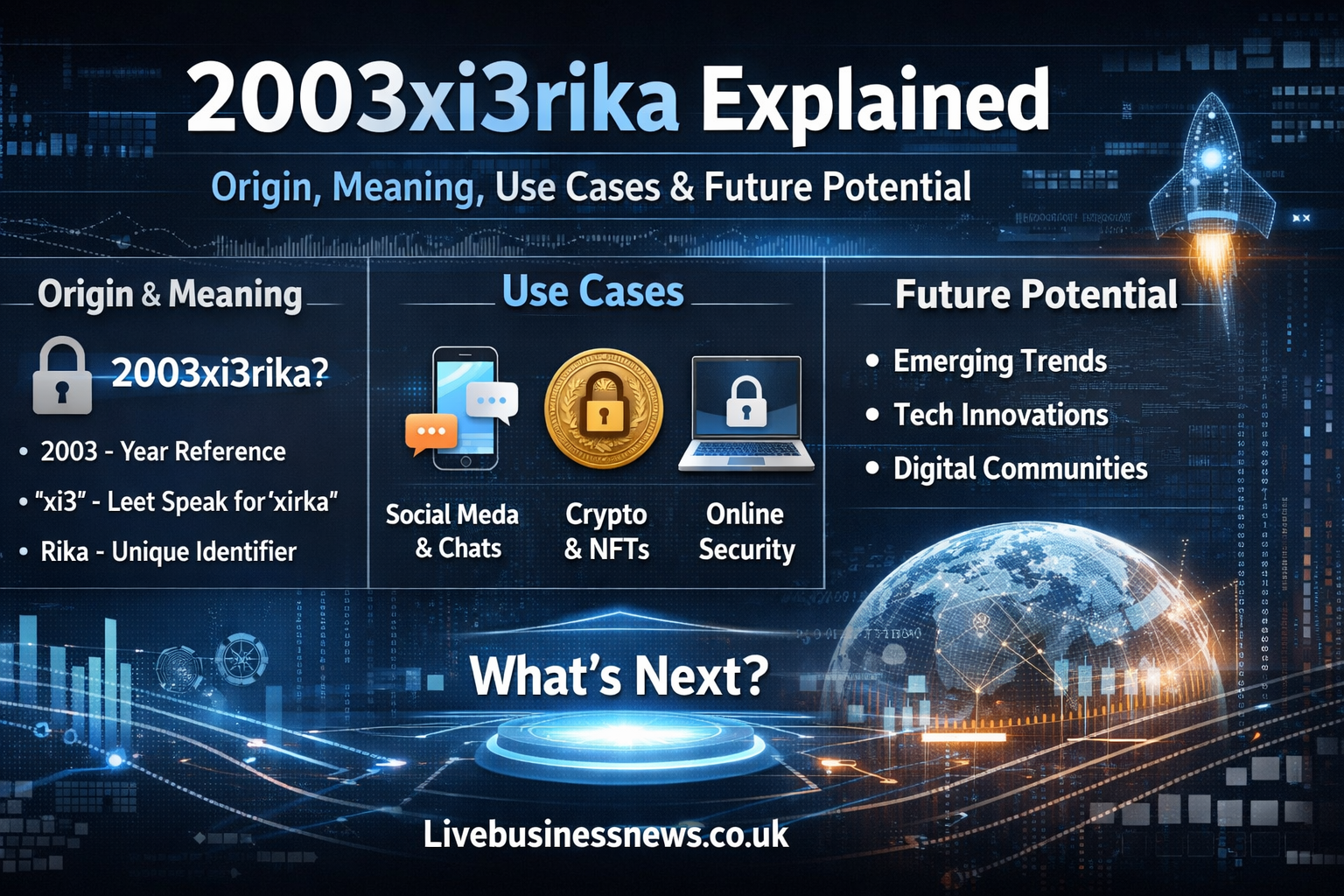
2003xi3rika: The Definitive Guide to Its Meaning, Origins, and Impact
In a digital landscape crowded with buzzwords and emerging concepts, 2003xi3rika stands out as a term that sparks curiosity and invites deeper understanding. Although unfamiliar to many, 2003xi3rika has rapidly become relevant in niche technology and cultural analysis circles. This article unpacks its origins, meaning, uses, and future potential to serve as the definitive resource for professionals, enthusiasts, and curious readers alike.
In the sections that follow, we explore what 2003xi3rika is, where it comes from, how it’s used across industries, and why it matters in today’s fast-moving digital world. You’ll find clear explanations, practical examples, expert insights, and answers to common questions — all grounded in a rich, accessible narrative that reinforces your understanding.
What Is 2003xi3rika? Understanding the Core Concept
At its essence, 2003xi3rika represents a conceptual framework that blends numeric symbolism with adaptive information structures. Think of it as a hybrid notation system designed to encode complex ideas, modular strategies, and evolving patterns into a compact form that’s easy to reference and manipulate. It’s less about the individual characters and more about what they collectively represent.
While many early interpretations treated 2003xi3rika as a cryptic code or even an esoteric cipher, the modern view positions it as a multidimensional tagging system. Organizations may deploy it to categorize trends, signal transitions, or anchor innovation pipelines. This adaptability has made 2003xi3rika a subject of study beyond its initial niche communities.
Origins of 2003xi3rika: Tracing Its Evolution
The journey of 2003xi3rika begins in experimental mathematics and semiotic research communities in the early 2000s. Scholars and innovators were exploring ways to merge numeric indices with symbolic representations, seeking systems that could evolve alongside human and machine cognition. 2003xi3rika emerged from these experiments as a robust conceptual prototype.
Its adoption accelerated when interdisciplinary labs began applying it to knowledge graphs and adaptive taxonomies. Over time, 2003xi3rika migrated into technology think tanks and cultural analysis groups as a flexible reference model. What was once an academic curiosity became a practical tool for mapping complexity in dynamic environments.
How 2003xi3rika Works: A Conceptual Breakdown
To grasp how 2003xi3rika functions, it helps to think of it as a composite identifier — a blend of numeric, alphabetic, and semantic layers. Each component carries meaning separately, and together they form a structural syntax that adapts to context. For example, 2003 can signify a baseline pattern, while xi3rika might encode thematic or procedural attributes.
This layered design enables 2003xi3rika to act as a cross-contextual reference. In practical terms, it helps systems and analysts align disparate datasets, map evolving trends, or tag emergent behaviors without rigid schema constraints. Its value lies in flexibility, precision, and interpretive richness.
Key Features and Benefits of 2003xi3rika
One of the core strengths of 2003xi3rika is its modularity. Unlike static labels, it accommodates shifting meanings and new associations without losing structural coherence. This makes it especially useful in environments where data and discourse evolve quickly.
Another benefit is interpretive density — 2003xi3rika can encapsulate multiple layers of information within a compact syntax. This density enhances storage efficiency, searchability, and analytical depth, particularly in systems that leverage semantic tagging or adaptive taxonomy frameworks.
Comparative Analysis: 2003xi3rika vs. Traditional Tagging Systems
Below is a structured view comparing traditional tagging systems with 2003xi3rika to clarify where it stands in modern information architectures.
| Feature / Aspect | Traditional Tagging | 2003xi3rika |
| Flexibility | Limited to predefined tags | Dynamic and adaptive |
| Semantic Depth | Shallow, context-dependent | Multi-layered interpretation |
| Scalability | Good, but rigid | Strong, evolving with input |
| Machine Interpretability | Standard | Optimized for semantic reasoning |
| Human Readability | High | Moderate, with learning curve |
| Use in AI Systems | Basic | Advanced semantic utility |
| Evolvability | Static | Designed for evolution |
This comparison highlights how 2003xi3rika extends beyond basic tagging to become a reference framework with broad potential applications.
Practical Applications of 2003xi3rika in Technology
In technology ecosystems, 2003xi3rika plays a role in structuring adaptive knowledge graphs, improving semantic search algorithms, and guiding machine learning feature tagging. For example, developers can use it to label training data in ways that capture evolving patterns rather than fixed categories.
By using 2003xi3rika-inspired structures, teams can also build more resilient information retrieval systems that anticipate shifts in user queries or contextual relevance. This positions organizations to respond faster to trends and changes in data behavior.
Storytelling Case: How a Startup Used 2003xi3rika to Innovate
Imagine a startup focused on personalized learning platforms. Their challenge was organizing vast content libraries so that recommendations reflected both user preferences and evolving educational standards. The team adopted principles derived from 2003xi3rika to construct an adaptive tagging schema.
“We realized that static tags weren’t enough,” said the project lead. “By embracing a 2003xi3rika-oriented system, we could track not just what content was, but how it related to users’ learning paths over time.” The result was a more responsive recommendation engine and improved user engagement.
This example illustrates how 2003xi3rika can bridge abstraction and practical implementation in real-world systems.
Cultural and Theoretical Context of 2003xi3rika
Beyond technology, 2003xi3rika has influenced conversations in semiotics, design theory, and cultural analytics. Its hybrid structure resonates with efforts to capture meaning that transcends rigid classification, reflecting how ideas and behaviors interweave across domains.
Academics appreciate 2003xi3rika for its capacity to model emergent phenomena, such as meme evolution, symbolic convergence, or discourse patterns. This cross-disciplinary interest underscores its value as both a conceptual and interpretive tool.
Misconceptions About 2003xi3rika — Clarifying Common Myths
A common misconception is that 2003xi3rika is inherently technical or only relevant to specialized fields. In truth, its principles are applicable wherever complex categorization and adaptive meaning-making are needed. Its structure can be simplified for broader audiences, and its insights inform both technical and human-centered practices.
Another myth is that 2003xi3rika is proprietary or opaque. While early use was limited to niche groups, its underlying design is open to interpretation and adaptation. What matters most is understanding how its components interact to represent layered information.
Future Trends: Where 2003xi3rika Is Headed
Looking forward, 2003xi3rika is poised to intersect with advancements in AI, knowledge representation, and digital cognition. As systems increasingly need to interpret nuance and context at scale, frameworks like 2003xi3rika can offer structured flexibility that traditional models lack.
Emerging ecosystems such as decentralized knowledge networks, context-aware agents, and interoperable semantic layers will likely draw on concepts that mirror 2003xi3rika’s adaptability. This positions the idea as more than a trend — but a foundational perspective in evolving digital infrastructures.
Expert Insights: Why 2003xi3rika Matters Now
2003xi3rika is not simply a label — it’s a lens for seeing patterns others overlook. This quote from a leading information architect captures the essence of why the concept resonates. The ability to encode, adapt, and interpret layered meaning is increasingly critical in environments driven by complexity and rapid change.
Professionals in analytics, knowledge engineering, design strategy, and even organizational leadership will find the insights around 2003xi3rika valuable as they build systems that need both depth and dynamism.
Implementing 2003xi3rika Strategies in Your Work
To apply 2003xi3rika principles, start by identifying domains where static classification limits insight. Ask how you might represent relationships, transitions, and context within your data or workflows. Then experiment with adaptive tagging that accommodates evolving meanings.
In practice, you might create prototypes that embed 2003xi3rika-like structures into metadata schemas, ontologies, or content labels. Monitor how these evolve and refine based on observed patterns. This iterative approach aligns with the conceptual intent behind 2003xi3rika.
Table: Use Cases Across Industries
| Industry | Use Case | Benefits |
| Education | Adaptive content tagging | Personalized learning paths |
| Healthcare | Patient data categorization | Context-sensitive insights |
| Finance | Market trend semantic mapping | Enhanced predictive modeling |
| Media | Content personalization | Increased engagement |
| AI Development | Feature representation | Deeper semantic training |
| Research | Thematic pattern analysis | Rich interpretation |
This structured view reinforces the breadth of contexts where 2003xi3rika principles can yield measurable value.
Deep Dive: Semantic Variants and Related Terminology
Related phrases and concepts include adaptive semantics, contextual tagging, multidimensional annotation, and dynamic indexing. These terms share conceptual DNA with 2003xi3rika, each emphasizing different facets of the broader challenge: how to represent meaning in flexible, evolving systems.
Understanding these related concepts enriches your grasp of 2003xi3rika and situates it within broader discourse on knowledge representation.
Practical Challenges and How to Overcome Them
One challenge in adopting 2003xi3rika structures is the initial learning curve. Because it departs from fixed categories, teams may struggle with interpretation and consistency. To mitigate this, provide clear documentation and examples that illustrate how components relate.
Another challenge is integration with legacy systems. Retrofitting adaptive frameworks requires careful mapping and validation. Yet by starting with pilot projects and aligning outcomes with business cases, organizations can gradually expand their use of 2003xi3rika-inspired approaches.
Conclusion
In a world where complexity grows faster than ever, 2003xi3rika offers a way to encode, interpret, and navigate meaning with flexibility and depth. From its conceptual origins to practical applications across industries, it stands as a dynamic reference model for adaptive information representation.
Whether you’re a technologist, strategist, researcher, or curious thinker, understanding 2003xi3rika equips you with a lens to engage with patterns that traditional systems overlook. With thoughtful implementation, its principles can enhance how you organize, analyze, and make sense of complex data and ideas.
Frequently Asked Questions
What does 2003xi3rika mean?
2003xi3rika refers to a hybrid conceptual framework designed to encode layered information in adaptive systems. It blends numeric and symbolic elements to facilitate flexible categorization and contextual interpretation.
How is 2003xi3rika used in technology?
In technology, 2003xi3rika principles help structure adaptive tagging, semantic search, and knowledge representation to improve machine interpretability and context-aware processing.
Can 2003xi3rika be applied outside tech fields?
Yes. 2003xi3rika principles apply to any domain that benefits from dynamic classification and interpretation — such as education, healthcare, research, and media.
Is learning 2003xi3rika difficult?
While the concept is abstract, learning 2003xi3rika becomes easier through examples and practical exercises that show how its components represent evolving meaning.
What future trends involve 2003xi3rika?
Future trends include its integration with AI reasoning, adaptive knowledge networks, and context-aware systems that require richer semantic frameworks than traditional structures offer.
 Admin
Admin